
If you are preparing for the IELTS exam, vocabulary is one of the fastest ways to improve your score. In fact, IELTS examiners consistently reward candidates who use a wide range of accurate, natural, and topic-appropriate vocabulary.
But here’s the mistake most candidates make: they try to use too many difficult words.
That approach often backfires.
In this guide, you will learn high-impact IELTS vocabulary that sounds advanced, stays exam-safe, and helps you score higher in both IELTS Writing and Speaking. These are the exact types of words and phrases examiners expect to see from Band 7, 8, and 9 candidates.
Let’s break it down step by step.
Why Vocabulary Matters So Much in IELTS
Vocabulary directly affects your score in two assessment criteria:
- Lexical Resource (Writing & Speaking)
- Coherence and Cohesion (when vocabulary is used to link ideas clearly)
Using strong vocabulary allows you to:
- Express ideas more precisely
- Avoid repetition
- Sound fluent and confident
- Demonstrate control of academic English
However, examiners are not impressed by rare or overly complex words used incorrectly. They are impressed by accurate, natural vocabulary used in the right context.
That is exactly what you will learn below.
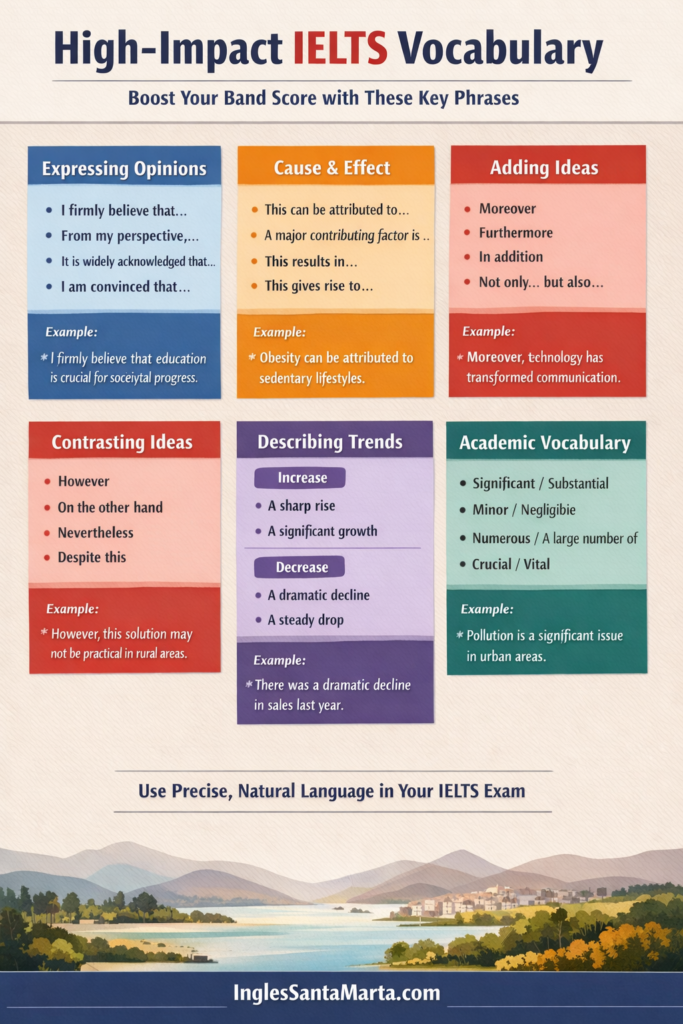
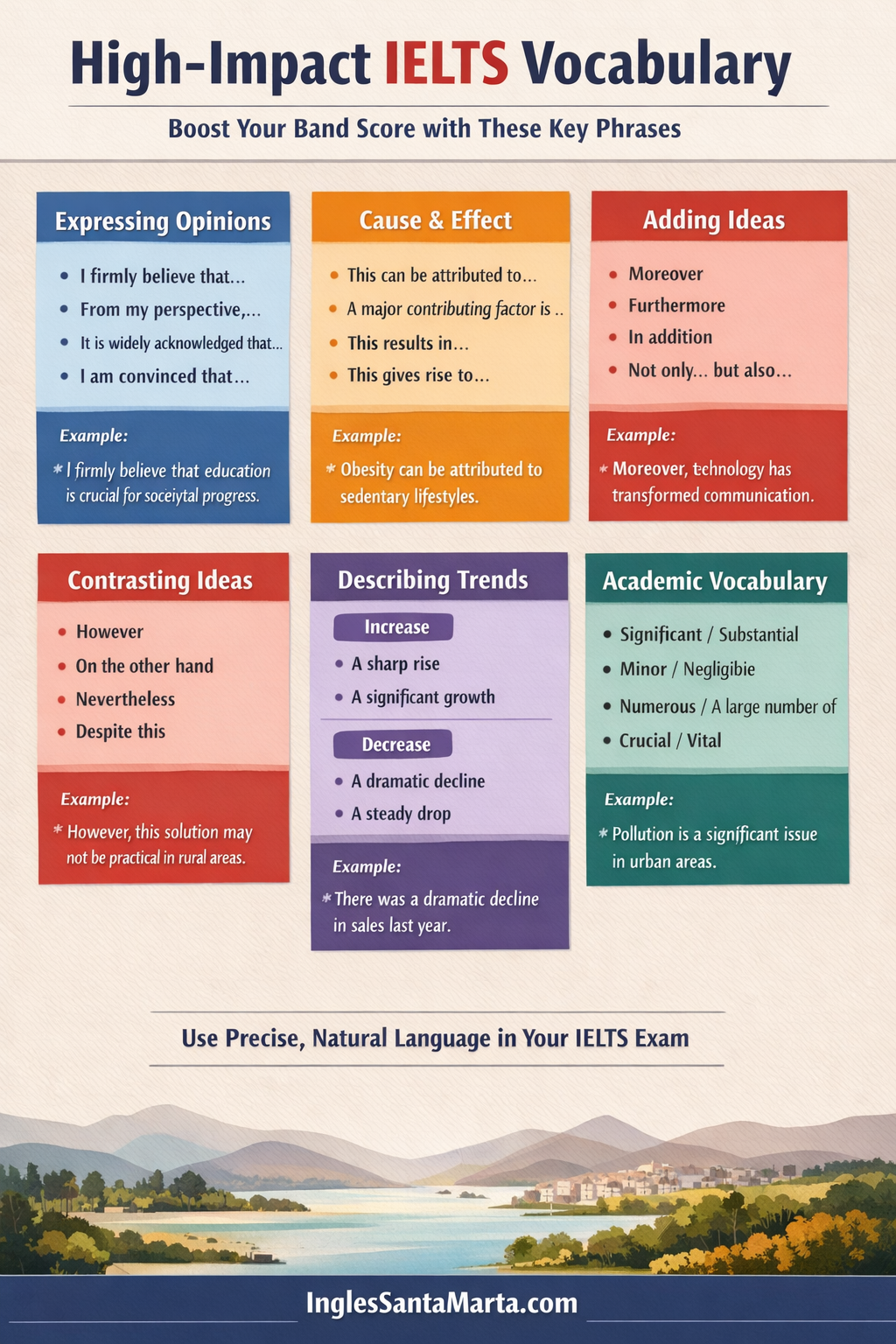
High-Impact Vocabulary for Expressing Opinions
In IELTS Writing Task 2 and Speaking Part 3, you are often asked to give your opinion. Repeating “I think” limits your score.
Instead, use these alternatives:
- I firmly believe that…
- From my perspective, …
- I am convinced that…
- It is widely acknowledged that…
Example:
I firmly believe that governments should invest more in public transportation to reduce traffic congestion.
Why this works:
These phrases show confidence and clarity, both of which examiners associate with higher-level language use.
Vocabulary for Cause and Effect (Essential for Task 2)
Many IELTS essays ask you to explain causes, effects, and solutions. Using precise language here is critical.
High-scoring options include:
- This can be attributed to…
- A major contributing factor is…
- This results in…
- This gives rise to…
Example:
The increase in air pollution can be attributed to the growing number of private vehicles.
SEO tip for IELTS candidates: mastering cause-and-effect vocabulary dramatically improves your score in problem-solution and discussion essays.
Linking Words That Improve Coherence and Cohesion
Coherence is not about using complicated connectors. It is about using clear and logical transitions.
Use these instead of repeating “and”:
- Moreover
- Furthermore
- In addition
- Not only… but also…
Example:
Moreover, this policy would benefit low-income families by reducing transportation costs.
Examiners look for smooth idea flow, not excessive linking words. One or two well-placed connectors per paragraph is enough.
Vocabulary for Contrasting Ideas (A Band Score Essential)
Almost every IELTS Task 2 essay requires contrast.
Use these instead of “but”:
- However
- Nevertheless
- On the other hand
- Despite this
- In spite of this
Example:
However, this approach may not be practical in developing countries.
Using contrast words accurately signals strong grammatical and lexical control.
IELTS Task 1 Vocabulary for Describing Trends
Task 1 is where many candidates lose marks by using basic verbs like “go up” or “go down.”
Replace them with precise trend language.
For Increases:
- A sharp rise
- A gradual increase
- A significant growth
For Decreases:
- A dramatic decline
- A steady drop
- A slight decrease
Example:
There was a dramatic decline in unemployment between 2010 and 2015.
Important note: never exaggerate. Match the word to the data.
Academic Word Upgrades That Instantly Raise Your Score
One of the easiest ways to sound more advanced is to replace basic adjectives and nouns.
Here are safe, examiner-approved upgrades:
- big → significant / substantial
- small → minor / negligible
- many → numerous / a large number of
- important → crucial / vital
- problem → issue / challenge
Example:
Education plays a crucial role in economic development.
These words are common in Band 8–9 responses because they are precise and natural.
Safe Idiomatic Phrases for IELTS Speaking
Idioms can be risky, but some are widely accepted and safe when used correctly.
Use these sparingly:
- Play a vital role
- On a daily basis
- A double-edged sword
- At the end of the day
Example:
Technology is a double-edged sword, as it improves efficiency but reduces face-to-face communication.
Do not force idioms. One well-used idiom is enough to impress an examiner.
Common Vocabulary Mistakes to Avoid
Many candidates hurt their score by:
- Using words they do not fully understand
- Memorizing advanced vocabulary without context
- Overusing synonyms unnaturally
- Writing long words instead of clear ideas
Remember: clarity beats complexity every time.
Final Examiner Tip
If you want a higher IELTS band score, focus on:
- Accuracy over difficulty
- Natural phrasing over memorization
- Relevance over repetition
High-impact vocabulary works only when it supports your ideas clearly and logically.